Wednesday, 8th February 2012.

Posted on Sunday, 19th September 2010 by Auw Jimmy

Post to Twitter

I’m thinking to create a first gift for my newborn (ooopsss… he is not yet here, just about to). A small MP3 Player with tiny amplifier to drive a small speaker should be a nice idea. I will introduce him to music as early as I can. So this could be the right time.

After searching around, I finally find a small chip amplifier, TBA820. It’s a small, 8-pins DIP type, low power at 2 Watt maximum on B-Class. Not a bad as a start. I don’t play with A or AB-Class due to heat issue. The goal is small design, almost no heat, and could be powered with battery when needed. This TBA820 chip amp should be excellent stuff.

The finished kit shown as below. With around 5 VDC power from battery, it could drive my tiny 2″ mini speaker at quite loud volume. Nice!

(more…)

Tags: , , ,
Posted in DIY Audio, Measurement, Personal | Comments (5)


Posted on Sunday, 8th August 2010 by Auw Jimmy

Post to Twitter

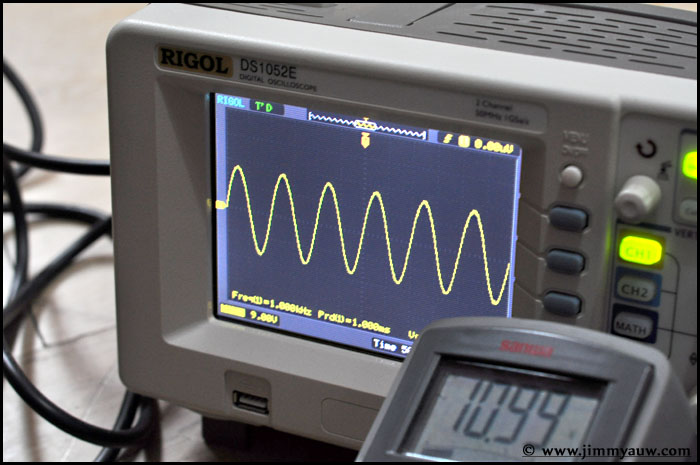
I was playing with my Rigol Oscilloscope to measure my laptop power output. The sound card was Realtek ALC660.

I played a 1 kHz sine wave with a software and measure the output. Since this was not an isolated environment (I have some application running on the background), so the frequency measured was not completely locked at 1 kHz.

On my typical daily usage, the output measured at 102 mV.

(more…)

Tags: , , , ,
Posted in DIY Audio, Measurement | Comments (4)


Posted on Sunday, 2nd May 2010 by Auw Jimmy

Post to Twitter

After reading my article about finding out capacitor inner-outer foil, some of my readers asked me to do the similar test on the resistor. Well, technically speaker, resistor shouldn’t have any inner or outer foil, since most likely it’s a piece of carbon or wire on the ceramic core. But let’s see the testing result. On this simple session, I used Kiwame (Carbon Film Resistor) and Mills (Wirewound). I also have some Riken or Shinkoh, but not really available in many values. For Kiwame, I used 1M, 470K, 100K, and 2K2. For Mills, I picked one value, 22K.

1 MegaOhm readings below showed 332 mV.

(more…)

Tags: ,
Posted in DIY Audio | Comments (27)


Posted on Saturday, 24th April 2010 by Auw Jimmy

Post to Twitter

I just got my Oscilloscope, so I can play more fun with my DIY stuff. Ok, let’s start with some basic “game”, to find the inner and outer foil of a capacitor.

Basically, most of the capacitor, has what we call the inner foil and outer foil. Because, most of capacitor’s construction is based on the winding of paper or other conductor (silver, copper, gold, etc), so we will have a start position (the inner foil) and the finish position (the outer foil).

Although for the film type capacitor, it’s just fine to connect positive or negative to the inner or outer foil. But due to some reason, it’s preferable to connect the outer foil to negative side or to the “nearest” negative side (input side on coupling application).

Why? Because the outer foil will catch the outside interferences. So better if you can put this outer foil to the place nearest to ground or negative pole. So it could completely transfer those unwanted noise faster to the place where it should belong – the ground.

Some capacitor like Audio Note, Jensen, Auricap, Hovland, VCap, etc usually marks their capacitor with different color lead or print some black line to mark the negative side or input in the coupling application. Some other popular capacitor, like Mundorf, doesn’t seem to care about this, means no marks at all. So you got to check it by your own. Other capacitor like Duelund, which uses the Stacked Foil design, I believe doesn’t have any polarity (it’s not winded, but stacked).

How to do the test with Oscilloscope? Simple by testing both leads, and give some “interference” outside the capacitor (touch by hand or put some electric field interference e.g. high voltage cable, etc). The side with higher noise, means the outer foil.

Below are some picture from my own measurement on some capacitors.

Audio Note Oil Filled Mylar Capacitor. The black line marking on the capacitor’s body means the negative or input side. We can see the noise is quite big if we put the positive probe on the side which has black line marking.

(more…)

Tags: , ,
Posted in DIY Audio | Comments (36)


About Some Audio Parts for Sale !!!