Saturday, 4th February 2012.

Posted on Saturday, 7th January 2012 by Auw Jimmy

Post to Twitter

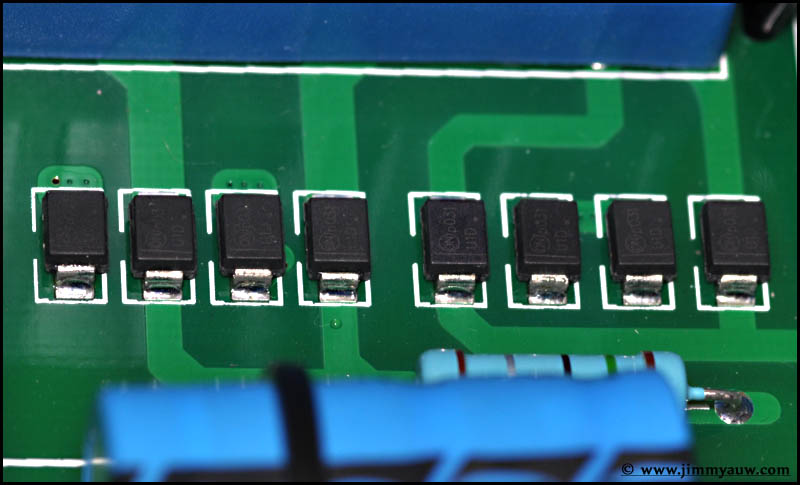
After the Part I has been done, now I continue to the Part II. On this 2nd part, I will see what’s wrong with the Marantz PM400AVK.

Simple testing method is to try it on other speaker. Initial diagnosis is the volume control problem, as I could hear some cracking and intermittent no sound on the speaker. But sometime the problem could be solved after turning the volume up and down. Definitely, initial problem is on the volume control. So let’s take a look inside.

(more…)

Tags: , , , ,
Posted in DIY Audio, Personal | Comments (0)


Posted on Tuesday, 15th November 2011 by Auw Jimmy

Post to Twitter

So far, Auricap is one of my trusted capacitor brand – in power supply section. I still remember ‘few’ years back (when using this capacitor for the very first time) and comparing with Solen, Hovland, and Bennic XPP in my very first DIY speaker. Sounds familiar – if you were ever there.

Now, time has changed, but Auricap remains there. Affordable and sounds quite natural capacitor. I receive information from my colleague that Auricap releases latest type, the XO series. Not quite sure why Auricap uses XO as their new model. Probably as this new capacitor also available in very larger version (100 uF++, if I’m not mistaken).

Auricap is still my favorite in power supply section, after Solen. Well, so far if you are thinking a full film capacitor power supply, then Solen is a nice and realistic choice, as they are available in large capacitance, adequate 400-630 VDC, and definitely affordable price. Now, with the arrival of Auricap XO, which also offers large capacitance and high voltage, then the different is all about money (and performance to justify the cost).

I order 0.1 uF / 400 VDC and plan to use them in power supply section of my new Aikido Preamp.

(more…)

Tags: , , ,
Posted in Collectible Stuff, DIY Audio | Comments (2)


Posted on Wednesday, 12th October 2011 by Auw Jimmy

Post to Twitter

I ordered Duelund CAST Cu capacitor few months ago. I already have Duelund CAST Ag (Silver) on my Aikido Preamp. But I wanted Duelund CAST for my future amp (probably it’s gonna be another abandoned project?). As the CAST Ag price is very not reasonable (around US$2500 or more for a pair of 1 uF/630 VDC), then I think the CAST Cu is the best option (around US$ 1200 a pair). I also ordered my Alexander by Duelund capacitor (less than US$ 200 a pair of 0.47 uF/900 VDC), just to ‘finalized’ my passion on it (how bad it could be?).

After around 3 months or so production, finally the goods arrived on my home yesterday. When I opened it, I got a surprise. Duelund changed their chassis design for the CAST capacitor. See below.

I think the design is more likely a ‘small car battery’. Quite nice, since the new design is smaller and it’s ‘boxy’ design could fit on most PCB easily, compared with the old ‘moon cake’ chassis design.

(more…)

Tags: , , ,
Posted in Collectible Stuff, DIY Audio | Comments (5)


Posted on Tuesday, 11th October 2011 by Auw Jimmy

Post to Twitter

It’s interesting to hear how does this low end capacitor would sound. So I eventually try to obtain it. I just can’t stop my passion in this. Sigh…

Priced at very low value (just a little bit more expensive than Audio Note Mylar version), this Alexander capacitor from Duelund got ‘unique’ 900VDC rating. Based on its specification and capacitance availability, I’m quite sure this is more for electronic circuit instead of crossover.

Interesting to hear how does it sound. I also order the new version of Duelund CAST Cu capacitor. Although they are at different level, but at how much? That would be remained as question, until I try it.

All I need is some more time… :)

Tags: , ,
Posted in Collectible Stuff, DIY Audio | Comments (9)


Posted on Tuesday, 30th August 2011 by Auw Jimmy

Post to Twitter

I have been a fan for Black Gate for quite long time. My first time impression probably nearly 10 years ago. I forgot whether I heard SKz or WKz at that moment, but I did remember the beauty of tube amplifier, smoothed by those Black Gate (probably not just Black Gate who contributed for the amazing sonic at that moment).

But 10 years back, I didn’t dare to play hundred of Volts for designing tube based equipment, then high voltage Black Gate such as SKz or WKz was out of my consideration. I got some and sell some… Mostly, I preferred to play with NX series, which very common in low voltage application (as low as 6.3 Volts). Very useful in D/A application. Some people say the Black Gate NX (especially the HQ – High Quality version) is very good in D/A coupling application. It produces very neutral sound, transparent, almost nothing (like direct coupling). But some people don’t like this kind of ‘sterile’ sound. Not analog, some people complaint.

Actually, other best application for Black Gate NX series is on the power supply smoothing section, especially on the D/A side.

I still own several N/NX/Hi-Q series, FK series, F series, PK series, Standard series, C series, and off course, the latest acquisition, SKz/WKz series.

All the latest WKz series (not WK, SK or SKz) will have a green ‘Goddess playing harps’ and  ‘Heart of Muse’ text. Actually, Black Gate is not the only one who uses ‘Muse’ in their capacitor series. We also can find Nichicon who uses ‘Muse’ in their line up. Term ‘Muse’ itself (one of them) could refer to any of 9 daughter of Mnemosyne and Zeus. Still on the same mythology, each of the Goddess possesses specific art or science. Probably this one loves music…

(more…)

Tags: , , , ,
Posted in Collectible Stuff, DIY Audio | Comments (7)


Posted on Friday, 13th May 2011 by Auw Jimmy

Post to Twitter

My cheap L/C Meter has arrived. With this new tool, I can play and explore more, especially things related with inductance, like Choke or Inductor. Although this is not the most accurate meter, but should be enough for typical daily usage. Before, I plan to take the Tonghui L/C Meter, which costs around 4x more. But this probably later on the future as this Tonghui is not easy to get. So at this moment, this cheap meter should work fine.

Below is the measurement result when measuring our previous DIY Choke.

(more…)

Tags: , , , ,
Posted in DIY Audio | Comments (8)


Posted on Friday, 10th September 2010 by Auw Jimmy

Post to Twitter

I have received some emails asking about “what is this Jensen 4-pole” and “what makes it different from other”. I will write down short explanation about it.

(more…)

Tags: , ,
Posted in DIY Audio | Comments (2)


Posted on Monday, 16th August 2010 by Auw Jimmy

Post to Twitter

It’s been a long since I promised to write this article: A comparison between Audio Note Copper Foil Mylar-in-Oil, Jensen Copper Foil Paper Tube, and Jensen Copper Foil Copper Tube. Some of my blog readers already email-ed me to ask about this. Due to my main job, I couldn’t finish this article immediately. So just this weekend, I spend few hours to have a listening session on this three capacitors.

Below is the test bed. A little bit awkward, but at least it works flawlessly!

(more…)

Tags: , , ,
Posted in DIY Audio | Comments (18)


Posted on Sunday, 16th May 2010 by Auw Jimmy

Post to Twitter

I plan to compare some capacitors from Jensen and one from Audio Note. The two from Jensen are Jensen Copper Foil Paper-in-Oil (Paper Tube) and Jensen Copper Foil Paper-in-Oil (Copper Tube). From Audio Note, I have Copper Foil Mylar-in-Oil (I believe this is Copper Tube also). We gonna have a serious battle later since those 3 caps are using different “recipe”. Both Jensen are Paper in Oil type, but with different enclosure. While the Audio Note has similarity with one of the Jensen with Copper Tube, but with Mylar instead of Paper. Audio Note claims the Mylar will provide better combination between sonic reproduction and the reliability.

Shall we prove the result? Later… We must wait after the burn-in session, probably in 100+ hours.

For the burn-in session, I sealed the Copper Tube caps with plastic. This is to prevent the oxidation of the copper tube (both Audio Note and Jensen Copper Tube oxides very fast in my environment due to high humidity, thanks to the purity of the material used also). I should prepare a transparent heatshrink for a good looking appearance, but no time to find one now. Perhaps you will ask why there are 2 pair of Jensen Paper Tube? One is my friend’s, to join the burn-in session before used on his system.

(more…)

Tags: , , , , , ,
Posted in DIY Audio | Comments (29)


Posted on Saturday, 24th April 2010 by Auw Jimmy

Post to Twitter

I just got my Oscilloscope, so I can play more fun with my DIY stuff. Ok, let’s start with some basic “game”, to find the inner and outer foil of a capacitor.

Basically, most of the capacitor, has what we call the inner foil and outer foil. Because, most of capacitor’s construction is based on the winding of paper or other conductor (silver, copper, gold, etc), so we will have a start position (the inner foil) and the finish position (the outer foil).

Although for the film type capacitor, it’s just fine to connect positive or negative to the inner or outer foil. But due to some reason, it’s preferable to connect the outer foil to negative side or to the “nearest” negative side (input side on coupling application).

Why? Because the outer foil will catch the outside interferences. So better if you can put this outer foil to the place nearest to ground or negative pole. So it could completely transfer those unwanted noise faster to the place where it should belong – the ground.

Some capacitor like Audio Note, Jensen, Auricap, Hovland, VCap, etc usually marks their capacitor with different color lead or print some black line to mark the negative side or input in the coupling application. Some other popular capacitor, like Mundorf, doesn’t seem to care about this, means no marks at all. So you got to check it by your own. Other capacitor like Duelund, which uses the Stacked Foil design, I believe doesn’t have any polarity (it’s not winded, but stacked).

How to do the test with Oscilloscope? Simple by testing both leads, and give some “interference” outside the capacitor (touch by hand or put some electric field interference e.g. high voltage cable, etc). The side with higher noise, means the outer foil.

Below are some picture from my own measurement on some capacitors.

Audio Note Oil Filled Mylar Capacitor. The black line marking on the capacitor’s body means the negative or input side. We can see the noise is quite big if we put the positive probe on the side which has black line marking.

(more…)

Tags: , ,
Posted in DIY Audio | Comments (36)


Posted on Tuesday, 23rd March 2010 by Auw Jimmy

Post to Twitter

After some crazy on the middle of the night decision, finally I decided to purchase the Duelund CAST Silver (CAST Ag) Capacitor. My friend bought my CAST Copper (CAST Cu), so this leaded me into a final crazy decision, to buy the CAST Silver.

The 1 uF and 630 VDC version of Duelund CAST Silver will cost you around US$ 900 each or around US$ 1800 pair. The 0.47 uF and 630 VDC version will cost about 5-7.5% difference, maybe different between retailers.

And don’t forget you have to wait around 2 months, not included shipping time, to get this at home – even if you have the money.

I was surprised to see that the outside appearance of this damned expensive CAST Silver was completely the same with my old CAST Copper. C’mon I spent over 2 times for this caps but with same appearance? Did you buy AMG with standard appearance? ;) At least I expected extra muffler, some body kits, new xenon head lamps, and some shinny grille.

cast-ag-front

The only different was, on the backside. You could side the sticker wrote 99.999% SILVER :)

cast-ag-back

I must wait several days or weeks, before I can judge this capacitor. But I do really anxious to hear how does it sound!!!

Tags: ,
Posted in Collectible Stuff | Comments (8)


Posted on Tuesday, 23rd March 2010 by Auw Jimmy

Post to Twitter

I acquired another varian of Jensen Film Caps, the Copper Tube. Basically, Jensen has 4 enclosure models, the cheap Aluminum Tube, then the Paper Tube, Copper Tube, and Ceramic Tube. So far, I have no interest (or budget) to try the Ceramic Tube, so I take the Copper Tube  (hope I made a good decision).

Inside, all of them should be the same. Just the enclosure is different. But I note a significant different in weight between the Aluminum Tube and the Paper or Copper Tube.

After several hours of break-in session, soon I will held a session between my favorite Paper Tube vs Copper Tube. This should be interesting, since Copper Tube is more expensive, and should provide an advantage – less interference, thanks to the Copper natural behavior.

But we must wait several days, or week, until they pass the break-in period.

jensen-copper-tube

Tags: , , ,
Posted in Collectible Stuff | Comments (26)


About Some Audio Parts for Sale !!!