Wednesday, 22nd May 2013.

Posted on Sunday, 31st March 2013 by Auw Jimmy

Post to Twitter

The first thing that we have to do before doing some mods activity is to find out who is where, why, and doing what. We can easily exclude when and how ;)

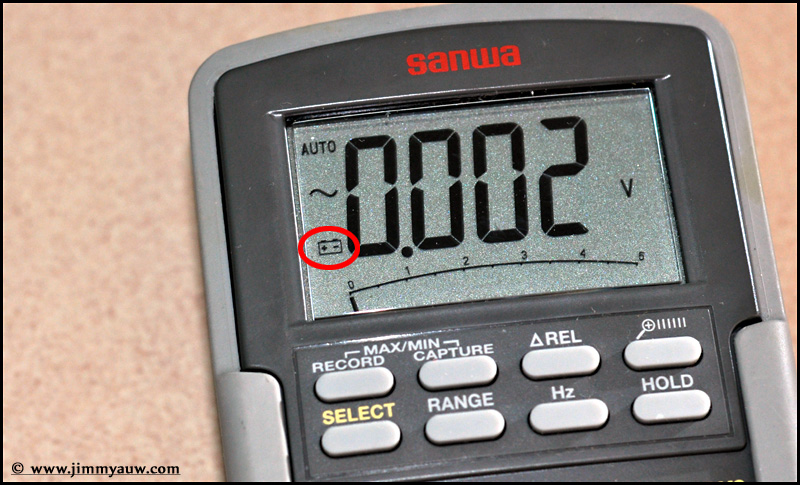
First, we need a AVO Meter. Any brand will do, as mostly we are testing for continuity only. Mostly, it will produce a ‘beep’ sound if it detects conductivity. Any cheap meter will do, started from $5. But I prefer a good tool, so I use my Sanwa PC510.

1-TracingXonar

(more…)

Tags: , , ,
Posted in DIY Audio, Measurement | Comments (16)


Posted on Monday, 24th December 2012 by Auw Jimmy

Post to Twitter

If you have read my previous article regarding the Sencore LC102, definitely you will notice that I have no power supply for this unit. After searching around, it seems quite impossible to get the original power supply (especially I’m living in Asia which has 220V line). The plug also quite unique with 3-prongs type. The worst scenario, I plan to patch some cables inside and change the plug.

Well, the spirit of DIY surely doesn’t allow me to give up. After reading Sencore LC102′s user manual, then I realize that this unit can be powered with 12 Volts battery. I believe the original battery should be either NiCd or SLA (forgot which one). I think we can use traditional AA battery to power up this unit, right?

Finding appropriate battery enclosure which could hold 8 batteries is not the toughest job. The toughest one is to find correct DC ‘female’ power jack which could match the DC ‘male’ jack on this unit. FYI, Sencore uses a quite big ‘male’ jack which put me some trouble to find the correct ‘female’ one. I try several laptop DC adapter jack and it just wont fit.

I visit several component shops to find a set of DC power jack, then finally I can find one that suit this Sencore LC102. Finally, we can wake up this amazing tool. Voila, it runs perfectly at this stage. Need some more testing to make sure its functions are working perfectly. But at this stage, at least all buttons and displays are working nicely.

Sencore LC102

(more…)

Tags: ,
Posted in Collectible Stuff, Measurement | Comments (2)


Posted on Sunday, 16th December 2012 by Auw Jimmy

Post to Twitter

During a lazy Saturday afternoon, there was a person asked on one of the mailing list about the orientation of the Bennic FPP capacitor. Unfortunately, I couldn’t find any Bennic FPP on my shelves. Only XPP was available. So here you go, the Bennic XPP Capacitor orientation check.

From the measurement, we can see that the outer foil of this Bennic XPP capacitor located on the left side (as we read ‘Bennic’ word from left to right). So theoretically speaking, this side should be use as input on the signal application or ground on the power supply application.

(more…)

Tags: , , , ,
Posted in DIY Audio, Measurement | Comments (12)


Posted on Saturday, 1st December 2012 by Auw Jimmy

Post to Twitter

I have been addicted with (vintage) measurement device for quite some time, maybe 5-6 years ago. This is not because of no reason. Vintage measurement device (mostly) uses high quality parts, because they were on ‘idealistic’ world. They were not so cost concern like most of the production line later these days. No surprise if such vintage device has a very long life and very durable. Also, don’t be surprise with the price tag to ;) One of my favorite is this one.

Back to the topic: I have acquired one of my ‘tool-of-the-dream’, a Capacitor Analyzer. This Sencore LC102 is one of the best tool for the purpose. Not only analyzing capacitor, this little stuff also can analyze inductor (if I remember correctly, it’s able to detect the short inside your transformer winding, cool eh?).

The bad thing, as most of the vintage device, unlikely we can get a fully complete unit with all accessories. So this is the same case. I need to find an appropriate power adapter (shouldn’t be a real problem as any 18VDC supply will do) and the test lead. The later one could need some time to get one.

(more…)

Tags: , , ,
Posted in DIY Audio, Measurement | Comments (5)


Posted on Sunday, 11th November 2012 by Auw Jimmy

Post to Twitter

If you have a lot of old tubes, then this idea could be useful. I have planned to make this small device, but somehow quite lazy (ugh!). I think because I have Knight 600 and Hickok 539B which are quite convenient to be used.

A background of this idea is, usually an old stock tube, either NOS or not, has been kept inside the box, attic, or warehouse for years. Some could be more than 10 years. Sometime, turn it on with maximum voltage could become a ‘heart attack’ for it. Well, it’s ok if it’s a cheap $2 tube. But how about for $400 RGN?

Usually I use my tube tester, either Knight or Hickok, and set lower filament voltage first for some time before putting an actual filament voltage to this kind of tube. But somehow, I would prefer to have a simple stuff but with more function. Here you go.

The ingredients are simple. Some hole saws (lucky if have quite vary of size). A thick platform or box is nice to have for this purpose (could be acrylic, wood, or metal plate). Some rulers to measure the size. Off course you will need a drill with some extra bits. It’s always nice to work if you have a complete stuffs.

(more…)

Tags: , ,
Posted in Collectible Stuff, DIY Audio, Measurement | Comments (0)


Posted on Tuesday, 20th December 2011 by Auw Jimmy

Post to Twitter

Finding a good soldering iron is not an easy job. But once you find it, it will simplify the rest of your life – I mean, the rest of your soldering life :)

One of my preference brand is Goot from Taiyo Electric, Japan. Although there are several affordable and also durable brand, but I think I’m quite OK with this Goot soldering iron (but remember, this is not the only brand in the world and the important is the man behind the gun, I mean, the solder).

I’m quite happy with CS-30 series which I bought maybe more than 7 years ago. It’s very durable. The main reason for me to change is the screw to remove the tip has broken (so I can’t change the broken tip). The new replacement is CS-31 which carries similar spec (25W version).

(more…)

Tags: , , , ,
Posted in Collectible Stuff, DIY Audio, Measurement | Comments (6)


Posted on Tuesday, 16th August 2011 by Auw Jimmy

Post to Twitter

Some people send me an email asking about how to measure cathode current and resistor rating. I will show you how to do it and actually this way is not only applicable for cathode resistor (but commonly used for that purpose).

Basically, there is 2 common way to do it. First, put you Ampere meter in series with the resistor. Second, is to measure the voltage on the resistor, then calculate the current based on the Voltage, Current, and Resistance formula (which V=I*R).

For the sake of simplicity, we can opt to use the second method. We cut the shrink from the resistor pins and put the probes there.

(more…)

Tags: , ,
Posted in DIY Audio, Measurement | Comments (2)


Posted on Tuesday, 16th August 2011 by Auw Jimmy

Post to Twitter

Sometime I’m curious how hot your tube is? Well, this short experiment will give you some idea. Different tube may have different thermal characteristic (simple logic: the higher current on the filament, expect higher temperature).

Off course we can use probe to measure the surface temperature. But I’m thinking another approach. So I get myself an infrared thermometer to examine the temperature in more detail. As example, I use Russia 5U4 Rectifier tube, rated at around 2A filament.

(more…)

Tags: , , ,
Posted in DIY Audio, Measurement | Comments (1)


Posted on Sunday, 7th November 2010 by Auw Jimmy

Post to Twitter

I used to like “hook-type” probe used in oscilloscope , as this type is very convenient in testing small parts. You just hook the test clip and see the result in the display. But why most multitester (Digital or Analog) uses standard probe? I don’t really got the idea.

So, let’s build by ourselves the oscilloscope-like probe for our multitester (you can call multimeter, DMM, or whatever).

You will need 3 major parts:

  • The connector head (to plug into your multitester)
  • Cables (AWG 18 or bigger, prefer insulated to cover at last 300V)
  • The “hook-type” (you can also call it spring clip type) probe

The minor parts needed:

  • Soldering iron and other soldering tools
  • Hairdryer or matches
  • Time (few hours)
  • Motivation (yeah!)
  • etc

Ok, first, put the cable on the connector head. Mine has screw to lock, but I put extra solder to make sure it will tight there forever and ever. See, they will be there, won’t release even you pull it hard.

(more…)

Tags: ,
Posted in DIY Audio, Measurement | Comments (1)


Posted on Monday, 1st November 2010 by Auw Jimmy

Post to Twitter

In the middle of the night, after finishing my tube rectifier dual socket modification, I prepare some tube rectifier to test the new socket. I think it’s gonna be nice to evaluate the sonic of some rectifiers to ;)

Actually, I have known the winner, although I haven’t compared them one by one on same setup – like this time.

Let’s start with Telefunken RGN 1054 Mesh, the basic or entry level tube rectifier from Telefunken. With the price around US$ 100 or less, this tube is just fine to let you know the special of RGN families. It sounds musical, crisp, and detail. The vocal is nice, although slightly thin. The Mesh Anode version is better in terms of transparency and musicality than the Solid Anode one.

(more…)

Tags: , , ,
Posted in DIY Audio, Measurement | Comments (20)


Posted on Sunday, 19th September 2010 by Auw Jimmy

Post to Twitter

I’m thinking to create a first gift for my newborn (ooopsss… he is not yet here, just about to). A small MP3 Player with tiny amplifier to drive a small speaker should be a nice idea. I will introduce him to music as early as I can. So this could be the right time.

After searching around, I finally find a small chip amplifier, TBA820. It’s a small, 8-pins DIP type, low power at 2 Watt maximum on B-Class. Not a bad as a start. I don’t play with A or AB-Class due to heat issue. The goal is small design, almost no heat, and could be powered with battery when needed. This TBA820 chip amp should be excellent stuff.

The finished kit shown as below. With around 5 VDC power from battery, it could drive my tiny 2″ mini speaker at quite loud volume. Nice!

(more…)

Tags: , , ,
Posted in DIY Audio, Measurement, Personal | Comments (5)


Posted on Sunday, 8th August 2010 by Auw Jimmy

Post to Twitter

I was playing with my Rigol Oscilloscope to measure my laptop power output. The sound card was Realtek ALC660.

I played a 1 kHz sine wave with a software and measure the output. Since this was not an isolated environment (I have some application running on the background), so the frequency measured was not completely locked at 1 kHz.

On my typical daily usage, the output measured at 102 mV.

(more…)

Tags: , , , ,
Posted in DIY Audio, Measurement | Comments (4)


About Some Audio Parts for Sale !!!