
It’s been a long since I promised to write this article: A comparison between Audio Note Copper Foil Mylar-in-Oil, Jensen Copper Foil Paper Tube, and Jensen Copper Foil Copper Tube. Some of my blog readers already email-ed me to ask about this. Due to my main job, I couldn’t finish this article immediately. So just this weekend, I spend few hours to have a listening session on this three capacitors.
Below is the test bed. A little bit awkward, but at least it works flawlessly!
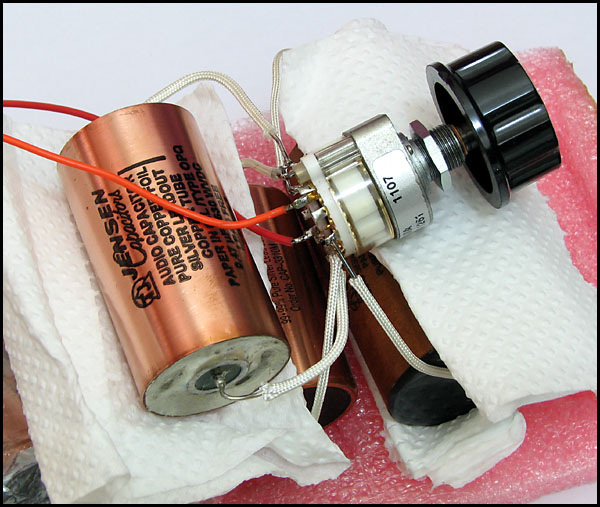
I always do such comparison test in real time. I want to make sure I could snap between capacitor in very short time, without too many delay. This to prevent “memory lost” of the sound of each capacitor.
My best choice is ELMA Selector, 2 poles, 6 positions. I could test up to 6 capacitors on the same time, just switch the button to select which capacitor that I want to hear.

Here is the contenders. All of them were actually “in-oil” type capacitors. Audio Note switches to Mylar based instead of Paper. According to them, the Mylar will give better durability instead of Paper. Their old Paper-in-Oil design has some reliability problem, thus they prefer to change the design. Jensen still loves the Paper, so both of the capacitors actually Paper-in-Oil design, with Copper Foil. Just different on the chassis, one is Paper, the other is Copper. Copper case makes the capacitor even heavier than the Paper tube. Does it make different? We will see (I mean, hear).

Ok we shall start the listening session. I pick some tracks from Norah Jones (Come Away with Me), Chen Lily LPCD45 (æˆ‘å’Œä½ ), Ingram Washington (My Funny Valentine), Eriko Ishihara (I’ve Got You Under My Skin), Ingebjorg Bratland (Mitt Hjerte Alltid Vanker), and Livingston Taylor (Isn’t She Lovely).
Due to limited time, I can’t write down my impression on each track, so I will give overall conclusion of each capacitor.
This new Audio Note Copper Foil Mylar-in-Oil has better high frequency resolution compared to the old one (Audio Note Copper Foil Paper-in-Oil type), but it’s just still not too “open” enough. The vocal is sweet, “swing and slow”, with good resolution. Staging is just enough, not too deep, but it’s quite well separated between the front, middle, and back side layer. At this price point (around US$ 55 each for 0.47 uF), I would say the performance is good to excellent. Good for overall performance, excellent if you do really like mid/vocal and not playing a lot of complex high frequency. I’m thinking a full-range driver performance to visualize the Audio Note capacitor sounds like (vs multi-way driver speaker). I would say, it’s your call to love or not to love this capacitor.

The Jensen Copper Foil Paper Tube was my favorite (before). I have used this capacitor for quite long time to replace the old Jensen Copper Foil Aluminum Tube. With price tag around US$ 100 each (0.47 uF), it’s actually quite serious capacitor on the market. We go straight to the sonic performance. It has good midrange, but with better high frequency extension compared to the Audio Note, maybe around 20-30% better in terms of high frequency, while maintaining the sweet vocal (just “enough” sweet). But still, for a very complex music with a lot of high frequency resolution instruments (we are talking about LP with live music genre), I think this capacitor is still not good enough (caveat: this is from my side, an owner of Duelund CAST Ag).

Finally, we come to the latest contender, the Jensen Copper Foil Copper Tube. The different between this capacitor and the previous one actually only on the case material. This one uses pure copper case instead of paper. Well, it’s quite easy to oxidize (same like the Audio Note), so be careful and pay extra care when handling this kind of capacitor. Compared to the Paper Tube, the Copper Tube provides even better high frequency extension. Surprisingly, the different is quite significant. If you are listening back to the Paper Tube, you will hear as if there is an extra layer between the singer and you. With the Copper Tube, the layer is removed. Clear vocal, better staging. But at some point of male vocal, it loses its weight, but not really significant. On the other side, with female vocal, I feel crispier vocal and slightly better resolution. You have to pay 10-20% more expensive for this Copper Tube compared to Paper Tube. Does it worth the upgrade? If you are listening mostly classic, rock, live, or any other kind of music which needs extra high frequency resolution, it’s definitely a nice to have one.

Brief conclusion:
- Audio Note comes back with its new Mylar-in-Oil design. Should have better reliability because of its new design and also have better high frequency extension. But I think Audio Note still emphasizes on the midrange band, as if we are talking a full range speaker here. It’s your call, not a matter of right or wrong. At US$ 55 each for 0.47 uF, the price is quite a bargain.
- Jensen maintains the old Paper-in-Oil design, but they are offering 4 type of chassis (Aluminum, Paper, Copper, and Ceramic). The overall vocal is quite sweet, but with added dynamic and high frequency extension. Surprisingly, the Copper Tube provides significant improvement. The Copper Tube has even better high frequency, separation, and resolution, although with a small trade-off on the midrange side. While the Paper Tube could be an all-round solution, sweet vocal, but with extra high frequency compared with the Audio Note.
- As comparison, I would prefer Copper Tube on 300B, Paper Tube on EL34, and Audio Note on KT88 Push Pull or perhaps 2A3.
- Sorry if my review sounds that I don’t really like all those three capacitors above. They are very good to excellent capacitors, really! But since my daily life is with the Duelund CAST Ag, so it’s very hard for me to get back. I’d try to be as objective as I can, but still I miss something when listening those three capacitors. If I should score the Duelund CAST Ag at 10, all of three above will get between 7.5 to 8. It’s quite good, right? Since the price different between Duelund CAST Ag and those three capacitors also very huge. Audio Note costs about US$ 55 each, Jensen around US$ 100-120 each (all 0.47 uF). The Duelund CAST Ag could cost over US$ 600 each! At fraction of cost, definitely those reviewed capacitors above have performed excellent sonic performance for most of my daily usage (the Duelund definitely not 5-10 times better as the price separates them).
VS Duelund CAST Ag:
Shortly after finished the comparison, I soldered back my Duelund CAST Ag (my current reference, priced around US$ 1500 /pair 1 uF). Well surely this capacitor is at different level with the previous three (again at 5-10 times price different). The high resolution is there, the vocal maintains its sweetness, staging is superb. All in perfectly harmony. I would say its musicality and microdetail are what we are talking about. All the tones seemed so balanced, well controlled, and proportional. This is the first capacitor which I could listen the Classic, Vocal, Jazz, or Pop, without afraid of losing their balance. Well, you got what you’ve paid though 😉


aphinx
August 16, 2010 15:36wauw …. ini review yang udah ditunggu-tunggu …. pilihan ke JPT memang tidak salah, at least untuk saat ini …. hehehehe ….
Auw Jimmy
August 16, 2010 17:16He he he… mungkin mesti coba sendiri yang Copper Tube baru bisa bicara lain he he he…
Thanks.
arie
August 16, 2010 21:32Woww… Thanks Oom Jim for the review! Wah wah.. Si ‘culun’ memang gawat tampaknya, gawat suaranya, gawat jebolin kantongnya hahahaha… Mantaff!!
Auw Jimmy
August 16, 2010 22:42He he he… memang dashyat Om… dashyat pula harganya… >.<
Dan Haines
August 23, 2010 19:25Something I would like to understand is why not use output transformers instead of the Dueland cap outputs? Does it require a different circuit topography? Or do you prefer the sound of the Dueland caps over output transformers for female vocals?
Thanks
Auw Jimmy
August 23, 2010 19:47Hi Dan,
I don’t really understand your question. Are you talking about pre or power amp? Interstage or Output Transformer?
The capacitor most of the time used as coupling, and replaceable with Interstage Transformer.
Output Transformer is different issue – I believe.
Thanks.
Tyo
August 23, 2010 22:11Oom Jim, sometimes people called preamp’s interstage as output transformer (as PIC of Hashimoto told me). That’s why in Hashimoto’s and Silk Trannie’s brochure they’re grouped as the same “animal”.
Just my 2 cent loh ya
Auw Jimmy
August 24, 2010 09:18Hi Tyo,
As far as I know, Silk (SAC Thailand, right?) separates their interstage and output transformer section. I’ve just checked their website again to confirm.
Not quite sure about Hashimoto, though.
Thanks.
Tyo
August 24, 2010 11:49Oops I’m sorry , yes they don’t put it as Output Transformer but as Preamp Line Output Transformer… hehe.
Auw Jimmy
August 24, 2010 21:16They name it as Silk Interstage.
http://www.sacthailand.com/Transformer_Interstage.html
Thanks.
Tyo
August 27, 2010 21:45Have you made comparison between high end interstage and Duelund oom JIm? Seems interesting……especially as you have expert ears to note the detail of high end product.
Auw Jimmy
August 27, 2010 22:20Not in exactly same system, and not really a high end interstage. But they both are on different league, as if we are talking which one is the best, Solid State or Tube Amplification. Both has their own pros and cons. You can win on one factor, could lose on other and vice versa.
Currently, I prefer the Caps Coupling instead of Interstage – on my ears. I’m not saying Caps is the best, just I prefer Caps.
Thanks.
Face
September 5, 2010 06:42Do you know how the ceramic or Al tubes compare to the Cu or paper tubes when used in the signal path?
Thanks,
Mike
Auw Jimmy
September 5, 2010 08:42Hi Mike,
Alu tube is nothing compared to the Paper tube. Almost no detail, but a little bit better than the old AudioNote in terms of high frequency. Old Audio Note seems for the real vocal lover only. But if you never heard Paper tube or other more expensive caps, I think Alu tube is just fine.
Copper tube has even more details, but somehow I miss the sweet midrange.
Never tried the Ceramic tubes though.
Thanks.
Teng
January 1, 2011 05:03I was thinking of mixing 2 V-cap CuTF with 2 Jensen Cu foil with paper shell. All 4 caps would be 0.22uF 600V. Of course Jensens are 630V instead. Let me know what you think about this mixture for my output tube section. As for my input coupling caps I am using 2 Sprague Vitamin Q’s 0.15uF 600V.
Let me know,
Teng
Auw Jimmy
January 1, 2011 11:56Hi Teng,
I don’t recommend combining output caps of 2 different caps.
Thanks.
John
March 25, 2011 01:51Jimmy, Audio Note (or I could have read this somewhere else) claims their new mylar/copper foil in oil caps need as much as three hundred hours for break-in. I’ve just recently experienced this with an Obbligato cap, where it really opened up only hundreds of hours later. Is it not premature to pass judegment on such a cap with only a 100 hrs of burn-in?
thanks,
John
Auw Jimmy
March 25, 2011 12:07Hi John,
If I could recall my memories well, all of this caps have passed over 200 hours of break-in period, which I’m quite sure it’s more than enough. It’s just a matter of different sonic characteristic, not a good-bad judgement.
Thanks.
Anonymous
October 16, 2012 15:31Teng,
i had try V cap TFTF combine with jensen AL foil and jensen cu foil.
i prefer V TFTF combine with jensen AL than with Cufoil.
Joey de Grano
March 23, 2013 07:22Hi Jimmy,
I have been following a lot of your tests and been so helpful to me with understanding audio stuff.
I’m in Vancouver Canada and I would like to ask you some questions regarding apparent replacement of my power amp capacitor.
The power amp is BAT Vk60 and it’s got 4 pcs of 0.22mF 630V capacitors (Jensen PIO Aluminum tube, I think).
I want to replace them with either the paper or copper tube Jensen PIO Will I get a significant improvement with this upgrade and can you tell me what sonic improvement I should be expecting. Or should I go straight to Dueland cast PIO Cu? but it’s too expensive.
Your advise will be highly appreciated.
More power to you,
Joey
Auw Jimmy
March 23, 2013 21:40Hi Joey,
How is your system now? I mean the sound?
And what is your expectation after the upgrade?
Thanks.
Anonymous
March 24, 2013 03:45Hi Jimmy,
Thank you so much for responding to my queries.
It sounds okay, the details and soundstaging are fine although it might need some more hi freq extension and decay.
What I’m trying to avoid is the vocal glare especially on female vocals, (when Holly Cole sings hi-pitch notes). The mid-high frequency is still hurting my ears, (kinda pink sound).
I was wondering whether changing the coupling caps on my power amp will solve the problem as I remember you talking about some capacitors having this issue and when replaced with duelund, it sounded right. (I think you mentioned it when comparing the alexander with the duelunds).
thanks,
joey
Joey de Grano
March 24, 2013 03:46Oh sorry, I forgot to fill out the sender info.
joey
Auw Jimmy
March 24, 2013 09:08Hi Joey,
For your case, I think Paper Tube would be a good start…
Thanks.
Joey de Grano
March 24, 2013 13:19Hi Jimmy,
Thanks a lot, I will order some Jensen PIO paper tube caps.
Joey
Auw Jimmy
March 24, 2013 19:59Hi Joey,
Ok, hope you enjoy it!
Thanks.
Joey de Grano
March 26, 2013 14:17Hi Jimmy,
I’d like you know that I went with Duelund Cast PIO instead of the Jensens. One question, do these Duelund CAST have polarity?
thanks in advance,
joey
Auw Jimmy
March 26, 2013 14:36Hi Joey,
Which version that you buy? Have picture?
Thanks.
Joey de Grano
March 27, 2013 05:57Hi Jimmy,
It’s this one, I ordered from parts conneXion:
Duelund Capacitors_ PIO 0.22uf / 630VDC, CAST-PIO-Cu, Copper Foil, 34mmD x 41mmH (27mm radial lead spacing) DUELUND-71504 $189.95
link:
http://www.partsconnexion.com/DUELUND-71504.html
I don’t know how to post pictures here.
thanks,
joey
Auw Jimmy
March 27, 2013 07:21Hi Joey,
I have no idea about that one. Never tried that. It’s custom order (Partconnexion version).
Thanks.
Joey de Grano
March 27, 2013 11:03Hi Jimmy,
I just learned that they are out of stock and can only ship the capacitors in May, I guess I’ll just cancel and get me some jensen PIO paper tube just like what you have suggested.
thanks,
joey
Auw Jimmy
March 27, 2013 11:16Hi Joey,
Good luck!
Thanks.
Joey de Grano
March 27, 2013 11:38Thanks Jimmy,
Joey de Grano
March 27, 2013 12:29Hi Jimmy,
Just wondering, where do you think I can find duelunc CAST PIO Cu 0.22mf/630V aside from Parts conneXion?
Do you have some with you that you want to sell or maybe some friends you know?
thanks,
joey
Auw Jimmy
March 27, 2013 13:44Hi Joey,
Send me a private email please. Will see if I can help you.
Thanks.
Joey de Grano
March 27, 2013 22:23Hi Jimmy,
I’ve sent my email, I don’t know your private email.
Please follow through.
thanks,
joey
Rasmus
April 24, 2013 06:07hi Jimmy
This is some reel interesting things you come up with here, for me at least it has been an eye-opener when it comes to capacitors. I read with great interest your “extreme capacitors battle†and for me and my wallet, Jensen Pure Copper Foil Paper Tube came out of the test as the best option. You mention, however, resolution as a problem with Jensen’s paper tube, while I of course want to have musicality in my system details matters and was really considering going all the way and buy Duelund. However, now I see that Jensen has launched a new series with pure silver foil (Silver foil/Silver leadout/paper in oil/paper tube). This might be the answers to my concerns. But do you have any experiences with them? According to Jensen the price is 3 times the one for copper foil.
I have ordered a new tailor-made 300B poweramp, with Tamura 7001 trafos and I am strongly considering spending the money on silver foil instead of copper.
Keep up the good work
Best
Rasmus
Auw Jimmy
April 24, 2013 10:14Hi Rasmus,
I have no idea with the new Paper Tube/Silver Foil version. Probably I’m interested to try it sometime later 😉 For now, I have no idea.
Seeing your 300B option, probably an additional touch of resolution will be good idea.
You have made a nice decision to go with 300B and Permalloy although Amorphous one could be another interesting option to.
Thanks.